| * | A game of go is divided into three stages: the opening, the middle game, and the endgame. | ||
|
|||
| Once the middle game is finished, the territories of each side have been more or less settled, so the game enters the endgame. In this stage, one puts the finishing touches to territory and settles the borders. | |||
| * | The endgame | ||
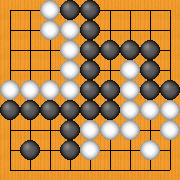
| Dia. 1. The fighting has finished and the players just have to put the
finishing touches to their territories. This stage is called the endgame. Where should White play next? |
|||
 |
|||
| Dia. 1 | |||
| * | Expanding and reducing territory | ||
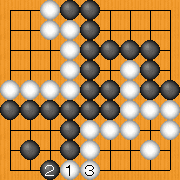
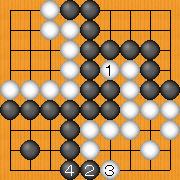
| Dia. 2. The white territory in the top left and the black territory in
the top right have already been completely surrounded, so all that is left
is to finish off the territories at the bottom. White 1 is the correct answer. White 1 is called a hane and 3 a connection. The combination is called a 'hane + connection'. Dia. 3. White 1 is a dame point that doesn't expand or reduce the territory of either side. In contrast, Black 2 reduces White's territory. |
|||
 |
 |
||
| Dia. 2. | Dia. 3. | ||
| If one compares the resulting territories . . . Dia. 2. Black: 17 points; White: 18 points. White wins by 1 point on the board. Dia. 3. Black: 18 points; White: 17 points. Black wins by 1 point on the board. |
|||
| As you can see, when the fighting in the middle game has been even, the result is decided by the final endgame. The hane + connection in Dia. 2 was played on the 1st line; if it is played on the 2nd line, it is even bigger. |
|||
| * | Losing points | ||
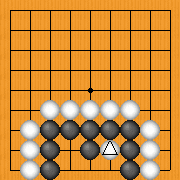
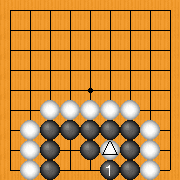
| Dia. 4. Black's territory is already complete. The marked stone inside his territory has been captured. At the end of the board, Black takes this stone off the board without playing any extra moves. Black's territory is 5 points; when you add 1 point for the captured white stone, that becomes 6 points. | |||
 |
 |
||
| Dia. 4. | Dia. 5. | ||
| Dia. 5. Black has added a stone at 1 to capture the marked white stone. Black has added a black stone inside his own territory, so its size has been reduced by 1 point. It is now worth 5 points. Black has suffered a loss through playing an unnecessary move. |
|||
| * | No loss, no gain | ||
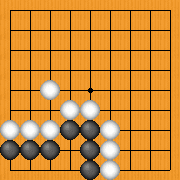
| Dia. 6. Black's territory is already complete. It is worth 5 points. | |||
 |
 |
||
| Dia. 6. | Dia. 7. | ||
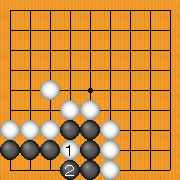
| Dia. 7. White invades at 1. This move is unreasonable, but if Black ignores it, some of his stones will be captured, so he captures 1 by playing at 2. |
|||
| In this case, White has lost a stone, but Black has also played an extra stone inside his territory, so the size of the territory is unchanged: plus one, minus one. | |||