| * | In ‘The opening (1)’ we learnt that the third and fourth lines in the corners are the most appropriate places to play the opening moves. Let’s have a look at where we can play the first move in the corner. |
|
 |
||
| Dia. 1 | ||
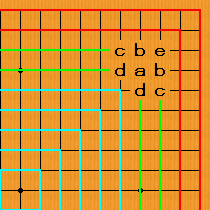
| The point ‘a’ is called the star point; the two ‘b’ points are the 3-4 points; the two ‘c’ points are the 5-3 (or 3-5) points; the two ‘d’ points are the 5-4 (or 4-5) points; ‘e’ is the 3-3 point. It’s generally considered that a move on the third line is good for surrounding territory but has weak central influence. In contrast, a fourth-line move has strong central influence, but is not so good at surrounding territory. |
||
| (a) The star-point | ||
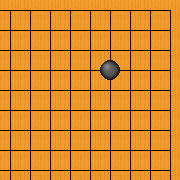
| The star point is the central corner point on the high 4th line. It exerts strong influence towards the outside and the centre. In contrast, it’s a little slack at taking territory. For example, White has room to make an invasion under it on the 3-3 point (‘e’ in Dia. 1). |
 |
|
| (e) The 3-3 point | ||
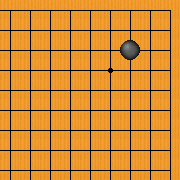
| The 3-3 is the central corner point of the low 3rd lines. It takes a tight hold on corner territory and stops White from invading. However, it has only weak influence on the sides and out towards the centre. |
 |
|
| (b) The 3-4 points | ||
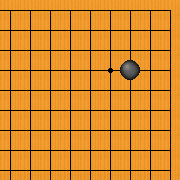
| The 3-4 points are one line lower than the star point. Of the standard corner plays, they are next lowest after the 3-3 point. The 3-4 point is convenient for surrounding corner territory, but because its aim is obvious, White will try to stop Black from surrounding territory by playing on ‘c’ or ‘d’, which would be the ideal follow-up points for Black. |
 |
|
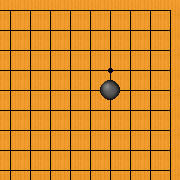
| (d) The 5-4 points. | ||
| These are one line higher than the star point. Because they are so high, it’s easy to White to invade the corner, so, rather than taking corner territory, they are oriented towards the centre. |
 |
|
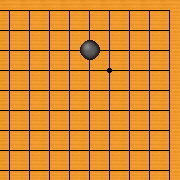
| (c) The 5-3 points | ||
| The 5-3 points are similar to the 5-4 points. Depending on how the opponent plays, they can switch either to taking territory or to a centre orientation. |
 |
|
| That concludes our discussion of the first moves in the corner. As you can see, even a single move has various different meanings. In ‘The opening (3)’, we will explain how to play from the second move on. |
||