 |
How to end the game | |
| Let's review the order in which a game is ended. | ||
| 1. | Agreement that the game is over | |
| 2. | Adding reinforcements, filling in the dame points | |
| 3. | Removing dead stones (and putting them into the opponent's territory) | |
| 4. | Rearranging the territories | |
| 5. | Counting the territories | |
|
Agreement that the game is over | |
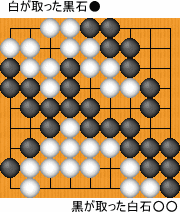
| Dia. 1. The players say to each other: "The game's finished." The game is over when both sides make this declaration. |
||
 |
||
| (Dia. 1. White has captured one Black stone. Black has captured two White stones.) |
||
|
Adding reinforcements, filling in the dame points | |
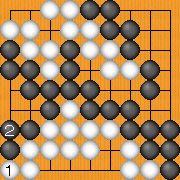
| Dia. 2. After the players have agreed that the game is over, White plays 1 and Black answers at 2. The latter move is called a reinforcement. Black must without fail defend at 2. If he doesn't, White will play at 2 himself and capture a stone. When all the necessary reinforcements have been made, the players fill in the dame points. |
||
 |
||
| Dia. 2 |
||
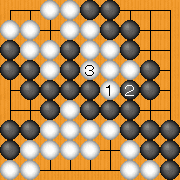
| Dia. 3. We mentioned earlier that the points that don't become territory for either side are dame points. It makes no difference which side plays on these points. In Dia. 3, the players fill the dame points with moves 1, 2 and 3. This clarifies the borders between the two sides. |
||
 |
||
| Dia. 3 | ||
| When the players have finished filling in the dame points, they next remove the dead stones from the board, but there are none in Dia. 3, so they proceed to rearranging the territories. |
||
|
Rearranging the territories | |
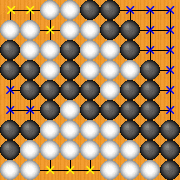
| The Black stone captured by White is placed in Black's territory, and the two White stones captured by Black are placed in White's territory. The territories are then rearranged to make them easy to count. |
||
 |
||
| (Dia. 4. The captured Black stone and the captured White stones are placed on the board.) |
||
|
Counting the territories | |
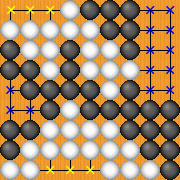 |
||
| Dia. 5 | ||
| Dia. 5. Black's territory is 2 x 5 + 3 = 13. White's territory is 3 + 3 = 6. Black is 7 points ahead on the board. If there was a one-rank difference between the players, then the result is the same: Black wins by 7 points. |
||
| If the players had played on even using nigiri, then there's a komi of
6.5 points, so that is subtracted from Black's score (or added to White's).
That means that Black wins the game by 0.5 points. |
||